Underfloor heating service · 24/7

Areas · Putney

Underfloor Heating Repair Putney

Service summary

Specialist underfloor heating repair, servicing and retrofit support across Putney. The postcode districts commonly serving this London district are SW15; district boundaries overlap nearby places, so we confirm coverage from the full address.

  • 45-minute response target
  • Wet & electric systems
  • London & South East
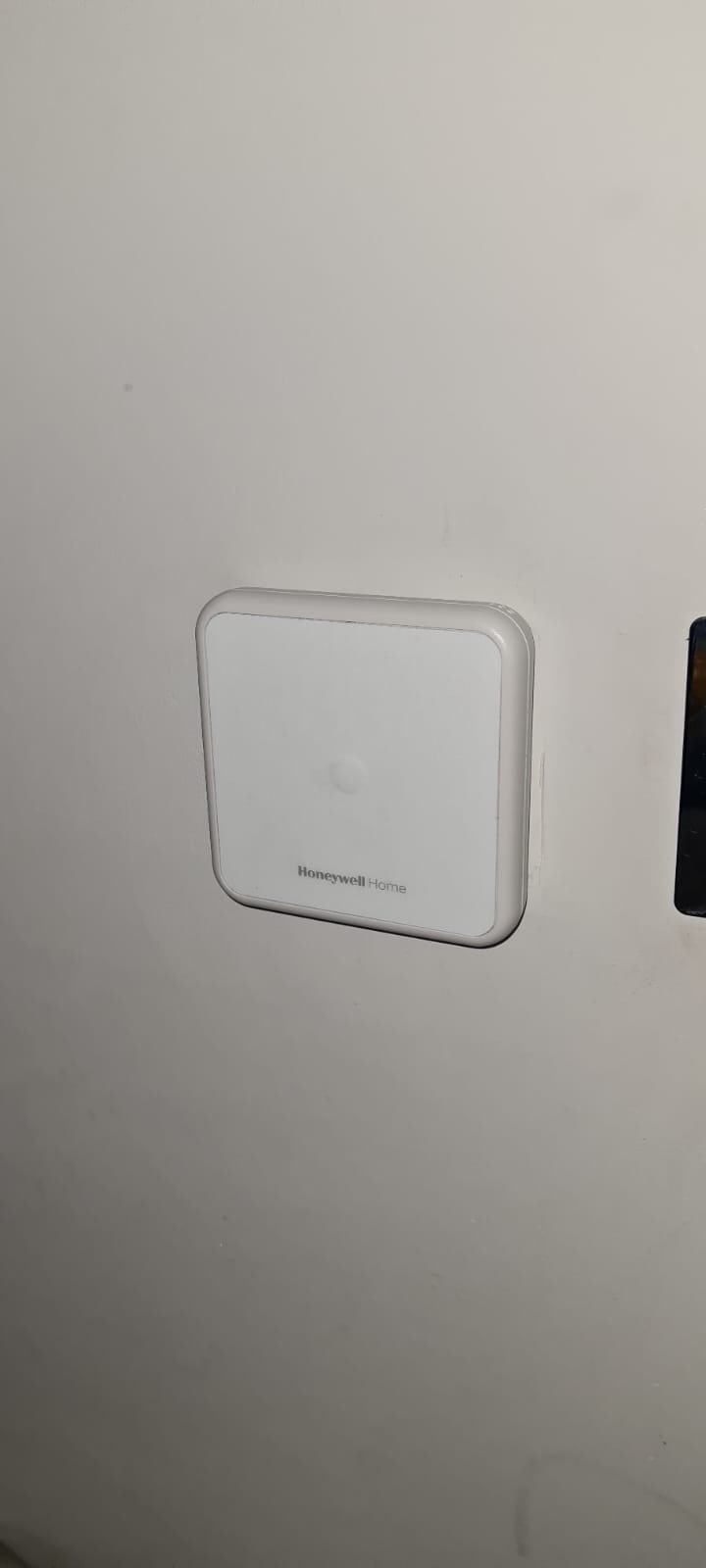
Honeywell Home wall control installed for a heating zone

From our work

The equipment behind the floor

Controls, actuators, pumps and manifold components work together to deliver heat to each zone. The correct checks depend on the symptom and the system installed.

Diagnostic signals

Areas we cover

  • Putney — SW15
  • Nearby coverage: Fulham, Barnes, Wandsworth, Roehampton
  • Wet manifolds, pumps, actuators and mixing controls
  • Electric thermostats, sensors and heating circuits
  • Planned servicing, balancing and recommissioning
  • Retrofit advice for existing floors and renovations

Engineer workflow

What our engineer does

  1. 1Confirm the full postcode, property access and affected rooms
  2. 2Identify whether the system is wet, electric or mixed
  3. 3Trace thermostat demand through controls and zone equipment
  4. 4Measure pressure, flow and temperatures where relevant
  5. 5Separate accessible faults from concealed circuit concerns
  6. 6Test repaired or adjusted zones through an operating cycle

Practical guide

Understanding underfloor heating repair putney

Local attendance is most useful when the engineer arrives prepared for the actual system. Clear information about the property, symptoms, controls and manifold helps distinguish an urgent loss of heating from a planned adjustment or service visit.

Specialist underfloor heating repair, servicing and retrofit support across Putney. The postcode districts commonly serving this London district are SW15; district boundaries overlap nearby places, so we confirm coverage from the full address. The aim is to establish what the system is being asked to do, what actually happens, and where that sequence stops. That keeps investigation focused and reduces unnecessary disturbance to floors, finishes and working components.

Start with the scope of the problem. One cold room suggests a different path from a whole system that never starts. An intermittent fault may point towards schedules, wireless communication, a sticking valve or a component that changes as it warms. A steady loss of pressure needs a different test from slow warm-up with stable pressure.

Underfloor heating also reacts more slowly than radiators, particularly where pipes sit within a thick screed. A correct diagnosis allows for that thermal mass. It does not assume that a floor should feel hot, and it does not raise water temperature simply to force a faster response.

Symptoms explained

What each sign can tell us

Putney — SW15

This observation narrows the search because it shows how the system behaves under demand. For underfloor heating repair putney, the next useful step is to compare the affected area with a zone that is operating normally. Note thermostat demand, visible actuator position, manifold flow, system pressure and any change in noise. Those observations help separate a local control problem from a circulation, temperature or buried-circuit issue.

Nearby coverage: Fulham, Barnes, Wandsworth, Roehampton

It is worth recording when this happens, which rooms are affected and whether the behaviour changes with the schedule. For underfloor heating repair putney, the next useful step is to compare the affected area with a zone that is operating normally. Note thermostat demand, visible actuator position, manifold flow, system pressure and any change in noise. Those observations help separate a local control problem from a circulation, temperature or buried-circuit issue.

Wet manifolds, pumps, actuators and mixing controls

The detail matters because several components can create a similar surface symptom. For underfloor heating repair putney, the next useful step is to compare the affected area with a zone that is operating normally. Note thermostat demand, visible actuator position, manifold flow, system pressure and any change in noise. Those observations help separate a local control problem from a circulation, temperature or buried-circuit issue.

Electric thermostats, sensors and heating circuits

A useful diagnosis compares this sign with pressure, temperature and control status rather than treating it in isolation. For underfloor heating repair putney, the next useful step is to compare the affected area with a zone that is operating normally. Note thermostat demand, visible actuator position, manifold flow, system pressure and any change in noise. Those observations help separate a local control problem from a circulation, temperature or buried-circuit issue.

Planned servicing, balancing and recommissioning

This can be intermittent, so photographs, error codes and a short timeline are useful before settings are changed. For underfloor heating repair putney, the next useful step is to compare the affected area with a zone that is operating normally. Note thermostat demand, visible actuator position, manifold flow, system pressure and any change in noise. Those observations help separate a local control problem from a circulation, temperature or buried-circuit issue.

Retrofit advice for existing floors and renovations

The correct response depends on whether the system is wet or electric and whether one zone or the whole property is affected. For underfloor heating repair putney, the next useful step is to compare the affected area with a zone that is operating normally. Note thermostat demand, visible actuator position, manifold flow, system pressure and any change in noise. Those observations help separate a local control problem from a circulation, temperature or buried-circuit issue.

A measured process

How local underfloor heating support should be approached

A methodical visit follows the demand from the room through the controls and into the heat-delivery system. The order matters: changing several settings or parts together can hide the original cause and make later verification difficult.

  1. STEP 01

    Confirm the full postcode, property access and affected rooms

    The result creates a baseline and prevents an unrelated component from being blamed for the problem. For this particular issue, findings from this step are considered alongside the symptoms you reported, rather than being treated as proof on their own.

  2. STEP 02

    Identify whether the system is wet, electric or mixed

    Testing is carried out in a logical order so each stage of the heat demand can be confirmed before moving on. For this particular issue, findings from this step are considered alongside the symptoms you reported, rather than being treated as proof on their own.

  3. STEP 03

    Trace thermostat demand through controls and zone equipment

    Measurements are compared across working and affected zones, which is often more informative than a single reading. For this particular issue, findings from this step are considered alongside the symptoms you reported, rather than being treated as proof on their own.

  4. STEP 04

    Measure pressure, flow and temperatures where relevant

    Any adjustment should be recorded so the system can be checked again under stable operating conditions. For this particular issue, findings from this step are considered alongside the symptoms you reported, rather than being treated as proof on their own.

  5. STEP 05

    Separate accessible faults from concealed circuit concerns

    Where a part is suspected, its supply, signal and mechanical response are checked before replacement is recommended. For this particular issue, findings from this step are considered alongside the symptoms you reported, rather than being treated as proof on their own.

  6. STEP 06

    Test repaired or adjusted zones through an operating cycle

    The final check is made with the system operating, not simply with a component powered on at the manifold or wall. For this particular issue, findings from this step are considered alongside the symptoms you reported, rather than being treated as proof on their own.

System knowledge

Controls, flow and floor construction

Controls: A thermostat creates a demand, but the signal may still need to pass through a receiver or wiring centre before an actuator opens and the boiler, heat pump, pump or zone valve is enabled. With underfloor heating repair putney, checking that complete sequence is more dependable than judging the wall display alone.

Water flow: Wet systems need the correct pressure, pump operation and flow through each loop. A visible flow meter can provide a clue, but its reading only makes sense when the relevant actuator is open and the pump is running. Air, debris, a closed valve or incorrect balancing can all reduce circulation without producing an obvious leak.

Temperature: Underfloor heating normally uses lower water temperatures than radiators. Mixing controls protect the floor and create a suitable flow temperature. Raising settings without understanding the design may waste energy, overshoot room temperatures or stress floor finishes while leaving the underlying fault unresolved.

Floor response: Tile, timber, vinyl and carpet transfer heat differently. Insulation below the system and the depth of screed or overlay influence warm-up and cool-down times. This is why surface temperature, room temperature and flow temperature should be considered together.

System interaction: Boiler or heat-pump operation, hot-water priorities and radiator zones can affect what is seen at the floor. The underfloor heating may be correctly requesting heat while another valve, setting or heat-source condition prevents delivery. Whole-system testing protects against a narrow diagnosis.

Before a visit

Safe checks and useful evidence

describe the affected rooms

Record what you can see without dismantling equipment. Keep settings stable long enough to observe the result, and compare the affected zone with a working one. This gives the engineer a useful starting point while avoiding changes that could obscure the behaviour of underfloor heating repair putney.

share photos and control details

Record what you can see without dismantling equipment. Keep settings stable long enough to observe the result, and compare the affected zone with a working one. This gives the engineer a useful starting point while avoiding changes that could obscure the behaviour of underfloor heating repair putney.

confirm access and parking constraints

Record what you can see without dismantling equipment. Keep settings stable long enough to observe the result, and compare the affected zone with a working one. This gives the engineer a useful starting point while avoiding changes that could obscure the behaviour of underfloor heating repair putney.

agree whether the visit is urgent or planned

Record what you can see without dismantling equipment. Keep settings stable long enough to observe the result, and compare the affected zone with a working one. This gives the engineer a useful starting point while avoiding changes that could obscure the behaviour of underfloor heating repair putney.

Safety first

If there is escaping water, an electrical smell or a repeatedly tripping circuit, make the area safe and explain this when calling. Avoid disturbing flooring or pressurised fittings before the fault has been located.

Repair decisions

Repair, adjust or replace?

Repair

Repair is usually the first option when testing identifies an isolated control, actuator, valve, pump connection or accessible fitting. The replacement must match the electrical and mechanical requirements, after which the operating sequence is tested again.

Adjust

Adjustment may be appropriate when components operate correctly but schedules, flow rates, mixing temperature or control logic no longer suit the property. Changes should be measured and documented, then reviewed after the floor has had time to respond.

Replace

Replacement becomes relevant when equipment has failed, is incompatible, cannot be serviced safely or prevents dependable control. A recommendation should explain what has been proved faulty, what remains serviceable and what commissioning follows the change.

A sound decision also considers access. Accessible controls and manifold parts are very different from a suspected fault beneath a finished floor. Non-invasive checks, circuit isolation, pressure testing and thermal observation should be used to narrow the location before intrusive work is discussed.

For planned improvements, comfort and control are better measures than whether the floor feels hot. A correctly operating system should deliver the room temperature required without excessive cycling or unnecessarily high flow temperatures. Changes should support that outcome rather than simply making one component run harder.

After work on underfloor heating repair putney, the affected zones should be observed through a complete demand cycle. Pressure, flow, temperature and control response are checked as relevant, settings are left in a known state, and the findings should be explained in plain language so future changes can be made deliberately.

Need the wider repair guide?

See our main guide to underfloor heating repair in London, or use the related links below to compare the most relevant fault, component and service pages.

Local service detail

Underfloor heating support shaped around the property

Putney is a London district within South West London. The area contains flats, terraces, conversions, newer developments and extended homes, so an enquiry may concern a single electric zone or a multi-loop wet system. A useful visit is organised around the installed system and the reported symptom, not assumptions based on the postcode.

Postcodes and coverage around Putney

The postcode districts commonly used across Putney are SW15. Postal districts are designed for delivery and do not define the boundary of a town, borough or county. The same district can cover several named places, while one locality can span more than one district.

Nearby places include Fulham, Barnes, Wandsworth, Roehampton. Those names are provided to make the coverage understandable, not to claim that every address shares one route or arrival time. The full postcode and practical access details are checked when the appointment is arranged.

Repair visits in Putney

The area contains flats, terraces, conversions, newer developments and extended homes, so an enquiry may concern a single electric zone or a multi-loop wet system. Diagnosis therefore starts by establishing whether the problem affects one room, one manifold or the complete system.

For a wet system, the heat request is followed from thermostat to wiring centre or receiver, actuator, pump, valves, heat source and loop. Pressure, flow and flow/return temperatures are interpreted under stable demand. For an electric system, safe electrical tests distinguish the thermostat or sensor from a concealed cable or mat concern.

Servicing and access preparation

Clear access to the thermostat, manifold, wiring centre and heat source helps the engineer follow demand without unnecessary disturbance. Model labels and wide photographs of the thermostat and manifold can help identify likely equipment before the visit, but electrical covers and pressurised fittings should remain closed.

Servicing is intended to document condition and performance. It can identify changing pressure, restricted flow, control problems or uneven distribution, but flushing and balancing are not automatic additions. They are considered only where the operating evidence makes them relevant.

Retrofit planning for South West London

Retrofit planning should resolve floor height, doors, stairs, kitchens, insulation and heat-source temperatures before a product is selected. The proposed output must be checked against the room heat loss at an appropriate water or floor temperature.

Low-profile does not mean no design work. Finished height, floor covering resistance, fixing zones, pipe or cable layout, manifold access, controls and commissioning all need coordination. A survey should also establish how the new zones will interact with existing radiators, a boiler or a heat pump.

How the real equipment photography is used

  • Genuine customer-supplied equipment photographs are used throughout the page
  • Coverage wording identifies Putney and its commonly used postcode districts without claiming exclusive postal boundaries
  • Diagnosis is based on live control, pressure, flow and temperature evidence
  • No local project, customer outcome or measurement is claimed without a verified record

Topic coverage

Topics explained on this page

underfloor heating repair Putney

underfloor heating servicing Putney

retrofit underfloor heating Putney

underfloor heating SW15

Technical answers

Questions we get asked

Which postcodes do you cover around Putney?

Putney is commonly served by SW15. These are postal delivery districts rather than exclusive town boundaries and may also serve Fulham, Barnes, Wandsworth, Roehampton. Send the complete postcode when booking so coverage and access can be confirmed.

Do you repair both wet and electric underfloor heating in Putney?

Yes. Wet systems are checked through their thermostats, wiring controls, actuators, manifold, pump, valves, pressure and loop flow. Electric systems require appropriate checks of supply, thermostat, floor sensor and heating circuit.

Can I book underfloor heating servicing in Putney?

Yes. A planned service can review accessible equipment, pressure, controls, actuator and pump response, representative flow and temperatures. Any fault repair, flushing or replacement is kept separate and recommended only when the findings support it.

Do you advise on retrofit underfloor heating in Putney?

Yes. Retrofit advice considers heat loss, insulation, floor construction, available build-up, thresholds, intended covering, manifold position and boiler or heat-pump temperatures before a system is specified.

Are the equipment photographs from this exact location?

Not unless a caption explicitly names a verified project. The photographs are genuine equipment images from our work and show the types of manifolds, controls, actuators and thermostats we inspect; they do not imply a local customer or result.

Need this sorted today?

Our line is answered 24/7 for urgent underfloor heating faults.

Local job record · Putney · Putney SW15 apartments

Putney SW15 apartments underfloor heating maintenance

UK Gas Plumbers supports the underfloor heating systems serving 168 apartments in Putney SW15 and holds the maintenance contract for the development’s communal plant room.

Putney SW15 apartments apartment manifold and underfloor heating controls

Project record

One development, two connected maintenance responsibilities

The project combines apartment-level underfloor heating support with ongoing responsibility for communal heating equipment. That distinction matters: a resident’s symptom may arise within local controls and distribution equipment, while the shared plant forms another part of the overall heat-delivery chain.

  • Apartment development, Putney SW15
  • 168 apartments
  • Communal heating and apartment underfloor heating systems
  • Apartment servicing, repair and replacement support
  • Communal plant-room maintenance contract held by UK Gas Plumbers

Confirmed scope

What UK Gas Plumbers provides in Putney SW15

Apartment underfloor heating

Across the 168 apartments, UK Gas Plumbers provides underfloor heating servicing, fault repair and equipment replacement. The service scope allows local issues to be approached through the complete operating sequence rather than treating the visible thermostat or manifold as an isolated component.

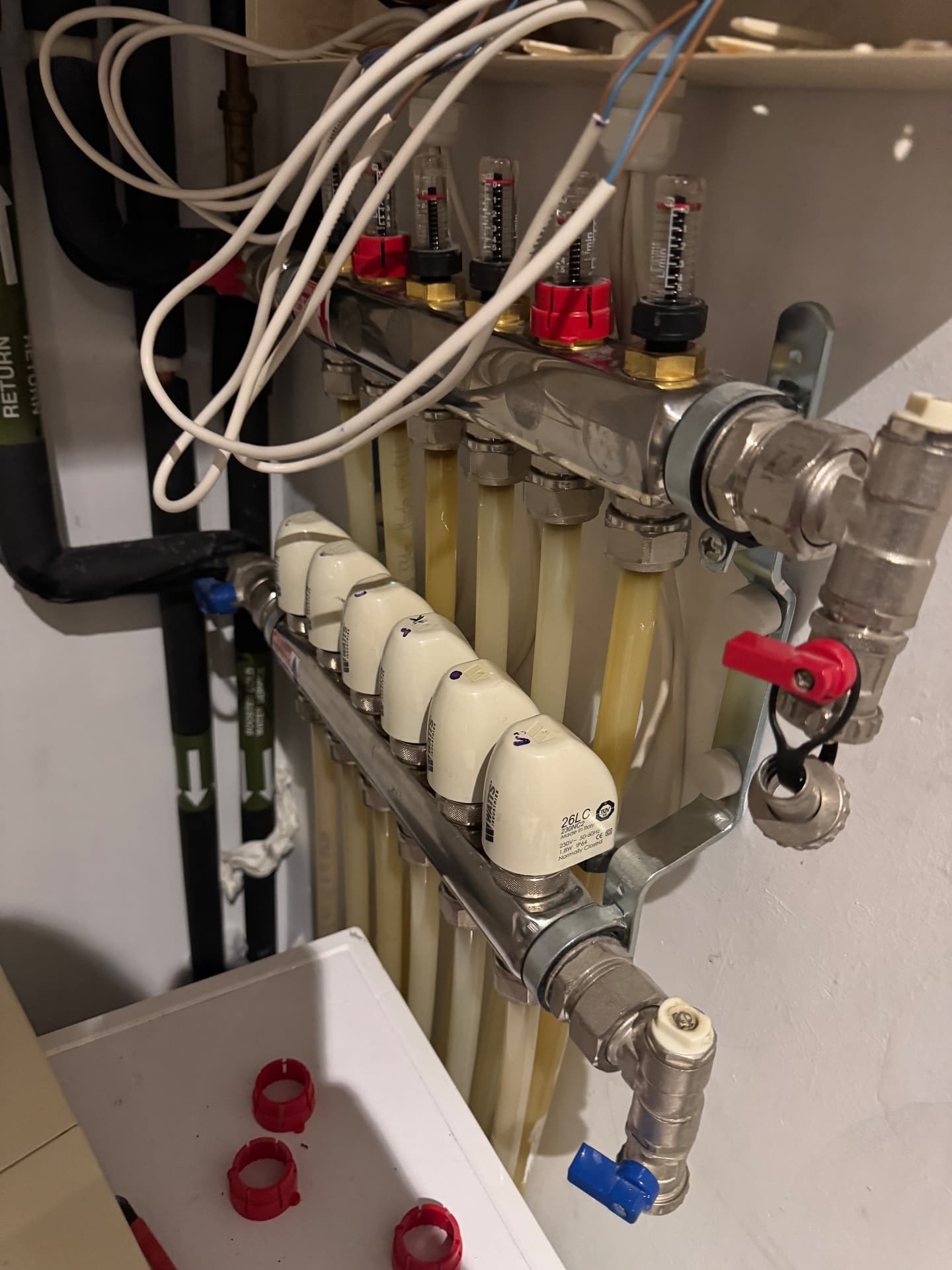
Apartment systems can include a room thermostat, control wiring, thermal actuators, manifold valves, flow indicators and connected floor loops. A demand for heat must pass through the appropriate controls and open the intended water path. Inspection therefore starts by confirming the reported symptom and identifying which parts of that sequence are relevant.

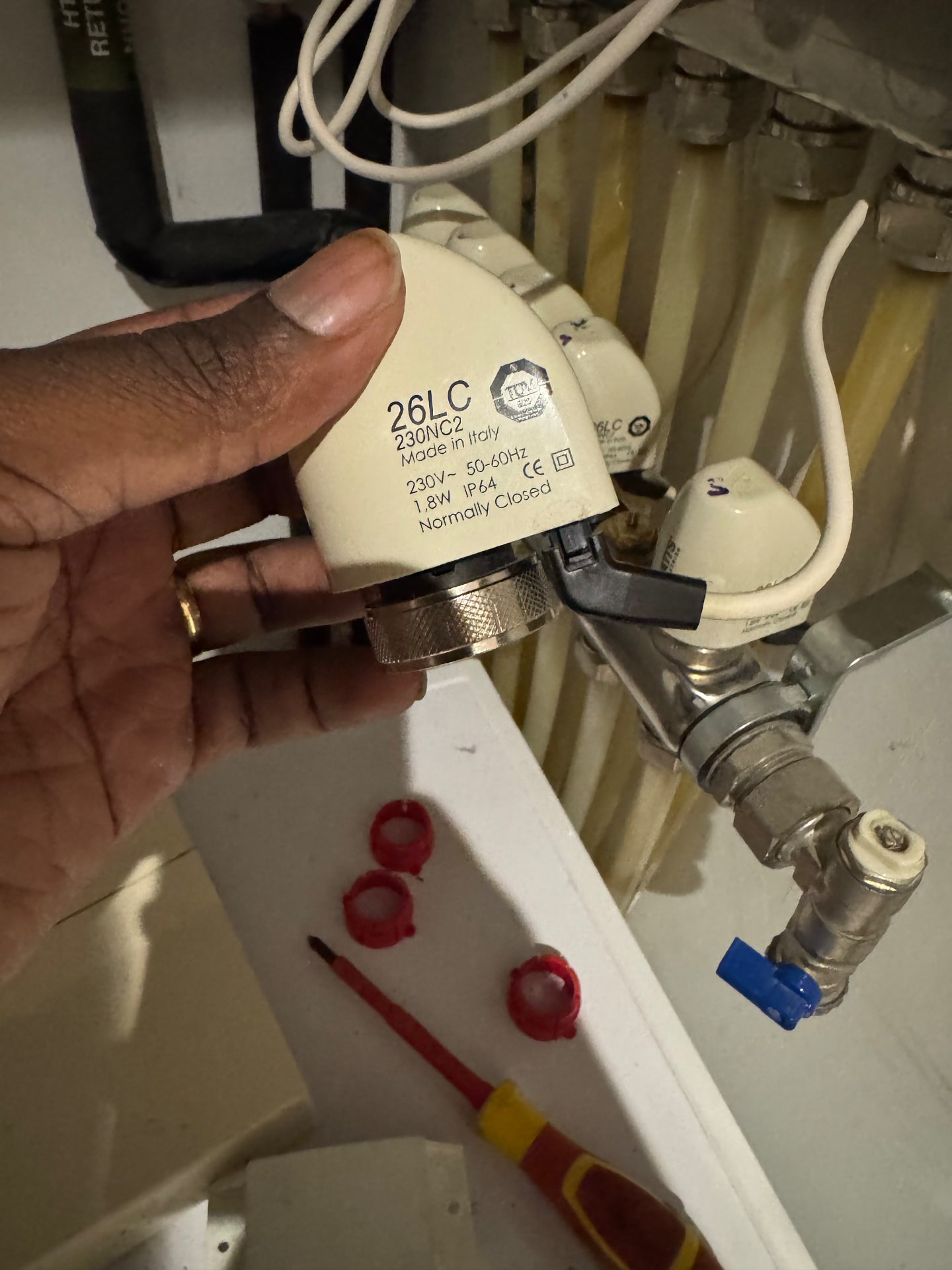
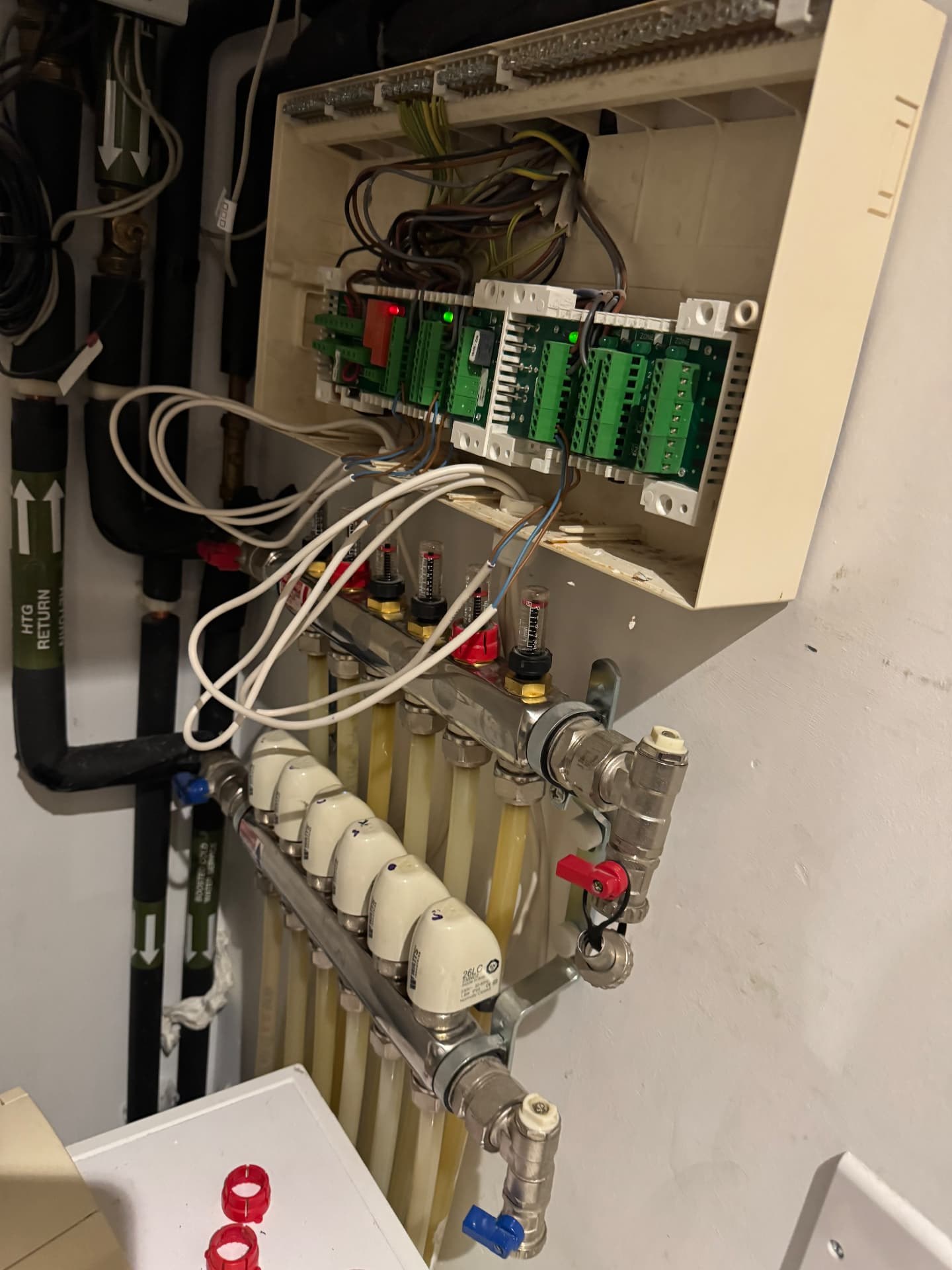
Replacement is not described as the automatic response to every fault. The installed component, voltage, connection, control arrangement and compatibility must be established before a part is selected. The photographs show why accurate identification matters: accessible equipment contains several separate devices whose conditions cannot be inferred from the room symptom alone.

Communal plant room

UK Gas Plumbers also holds the maintenance contract for the communal plant room in Putney SW15. This creates continuity between the shared heating infrastructure and the underfloor heating systems within apartments while keeping the responsibilities of each part clear.

In a communally heated development, an apartment symptom must be considered in context. A local control, actuator or manifold condition can prevent heat reaching one zone even when communal heat is available. Conversely, a wider supply condition can affect more than one dwelling. The pattern of reports and live system behaviour helps determine where investigation should begin.

The maintenance relationship provides an established route for planned attention to the communal plant and for apartment-level service, repair or replacement enquiries. This case study does not publish private plant specifications, maintenance dates or measured results that have not been supplied for public use.

Project photography

Installed apartment controls and distribution equipment

These five photographs are attributed to the Putney SW15 apartment project. Captions identify only what is visibly shown. They are not presented as before-and-after pairs and do not imply a specific fault, replacement or measured result.

Open wiring control enclosure above an apartment underfloor heating manifold in Putney SW15
Apartment distribution equipment: the open control enclosure, manifold flow meters, actuators and primary flow and return connections.
Underfloor heating thermal actuator inspected in Putney SW15
A removable 230-volt normally closed thermal actuator being identified at the manifold.
Warmup thermostat serving an apartment in Putney SW15
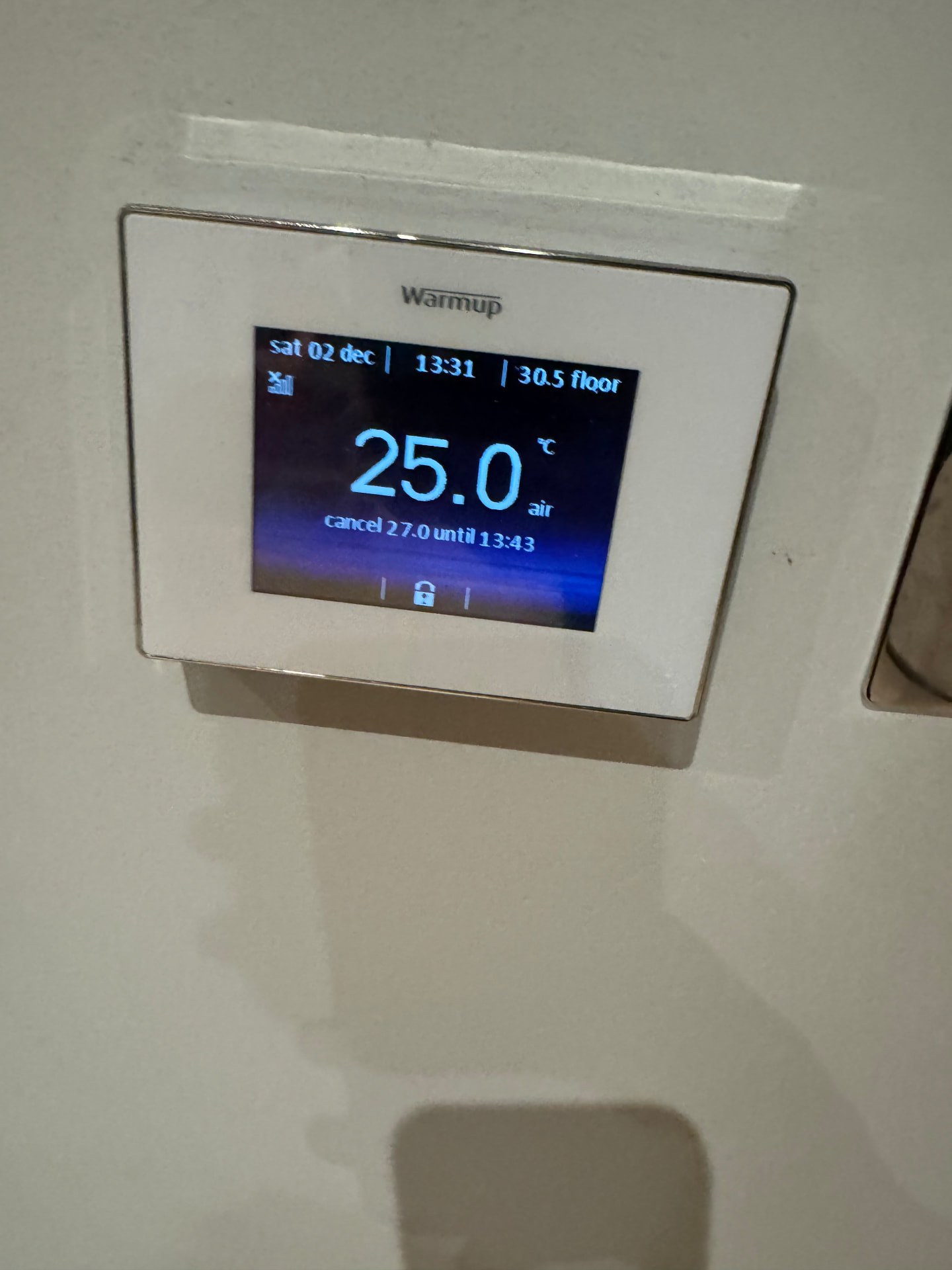
A Warmup room and floor thermostat, one of the local controls that forms part of an apartment heating sequence.
Multi-loop underfloor heating manifold in Putney SW15
A multi-loop apartment manifold with flow indicators, actuators, isolation valves and connected floor circuits.
Row of underfloor heating actuators on a Putney SW15 apartment manifold
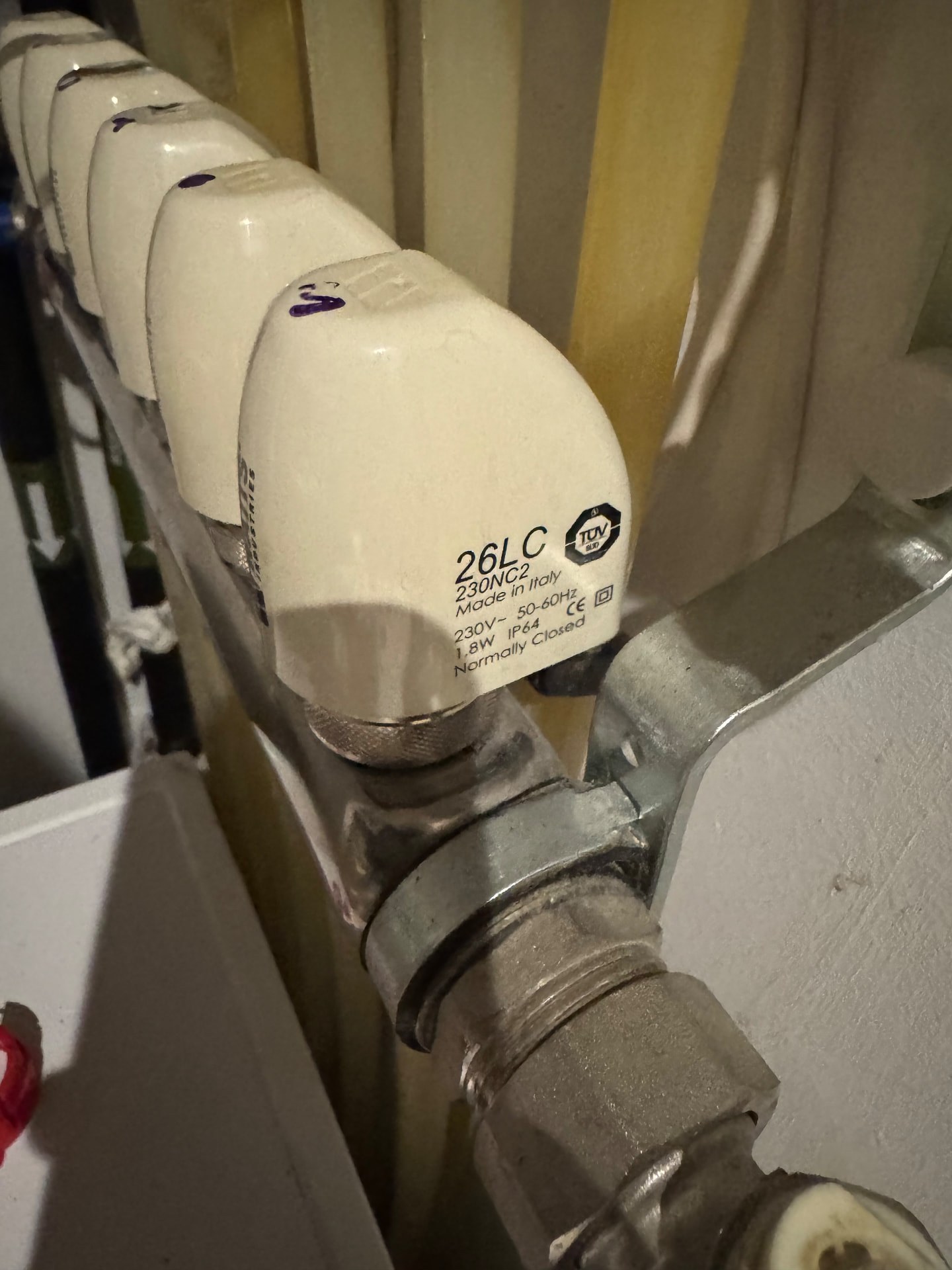
Close inspection of the actuator bank and manifold connection at an apartment system.

Technical context

How apartment underfloor heating is assessed

Begin with the extent of the symptom. One cold room, several affected zones and a complete loss of heat point towards different parts of the system. The thermostat display is useful evidence but does not on its own prove that its output, the wiring controls, actuator or water circuit is operating. In a multi-apartment development, it is also useful to establish whether the report is isolated or shared.

Follow the call for heat. A wet underfloor heating zone normally depends on a thermostat or sensor, a control output, an actuator and an available source of heated water. The actuator shown in the project photography is marked as a 230-volt normally closed device. That visible specification is important when testing or choosing a compatible replacement, but the label alone does not state whether a particular zone was faulty.

Check circulation under a genuine demand. Flow indicators become meaningful when the appropriate zones are open and the system has been given time to operate. A zero or low indication may relate to actuator position, a manifold valve, trapped air, a circulation condition, a restriction or the indicator itself. Pressure, flow and temperature each describe different behaviour, so no single reading should be treated as a complete diagnosis.

Separate local and communal systems. The apartment manifold distributes water through local floor circuits; the communal plant provides shared heating infrastructure. A structured check avoids unnecessary intervention in one area when the evidence points to another. It also helps communicate whether an issue belongs to apartment equipment, shared supply or an interaction between controls.

Recheck after work. Where servicing, repair or replacement is completed, the relevant zone should be observed through an operating sequence. The purpose is to confirm that demand is received, the water path opens and the expected response begins without creating an obvious issue elsewhere. Floor construction means room response is not instantaneous, so immediate surface sensation is not the only test.
Ongoing maintenance

Why continuity matters in a 168-apartment development

A development of this scale can generate very different heating enquiries. One resident may report a thermostat that appears to call for heat, another may have one cold room, and a wider group may notice a change at the same time. Keeping apartment support and communal plant maintenance within an established service relationship makes those patterns easier to distinguish without assuming that every report has the same cause.

Apartment records are valuable because underfloor heating equipment is not always identical throughout a development. Controls and actuators may have been replaced at different times, settings may vary, and access arrangements can differ between homes. Identifying the equipment actually present remains essential even when engineers know the building and its heating arrangement.

Planned servicing and reactive repair also serve different purposes. Servicing provides an opportunity to inspect accessible equipment and record how it behaves while it is operating. A repair visit starts from a reported failure and concentrates testing on the affected sequence. Replacement follows when the evidence and component condition support it, rather than being bundled automatically into routine maintenance.

Communal plant responsibility adds an important reference point. If several reports follow the same pattern, shared conditions can be considered alongside local apartment equipment. If neighbouring apartments are operating normally, investigation can focus more closely on the thermostat, control output, actuator, manifold valve and loop serving the affected home. Neither observation replaces testing, but each helps set an efficient direction.

Clear communication is particularly important where residents, building management and maintenance teams may all be involved. The affected apartment, rooms, timing of the symptom and any visible display or pressure information should be recorded accurately. Safe photographs of accessible controls can support preparation, while electrical covers and pressurised fittings should be left for the attending engineer.

The Putney SW15 apartments relationship demonstrates the practical breadth of UK Gas Plumbers’ work: support inside individual apartments and maintenance of the shared plant serving the development. The published record deliberately stays within that confirmed scope. It does not attach an invented completion date, fault history, performance improvement, customer quotation or technical reading to the project.

Questions about the project

Putney SW15 apartments FAQs

Where is this development?

The development is in Putney, London SW15. The building and street are not named to protect residents.

How many apartments are covered?

The development contains 168 apartments. UK Gas Plumbers provides servicing, repair and replacement support for apartment underfloor heating systems.

Does the work include the communal heating system?

Yes. UK Gas Plumbers also holds the maintenance contract for the communal plant room serving the development.

Are the photographs from this project?

Yes. The photographs on this page were supplied for the Putney SW15 apartment project and show apartment-level controls, a thermostat, actuators and manifold equipment.

Does every apartment have identical equipment?

This case study does not claim that every apartment has an identical arrangement. Equipment must be identified and tested in the apartment being attended.

Can you provide the same service elsewhere?

Yes. Repair, planned servicing, manifold work and control replacement are available across London and the South East, subject to access and appointment availability.

Need support for an apartment or managed development?

Tell us the number of affected zones, the system type if known, access arrangements and whether the concern appears local or shared.

London and South East England

Completed-job locality

Completed-job map: Putney, London

This map shows the general Putney, London area only. It is not the customer’s address and not our branch. It accompanies the 5 existing same-job photographs in this case record.

Putney, London

Google Maps loads only when you choose to load it. You can also open the external map instead.

Open Putney, London in Google Maps